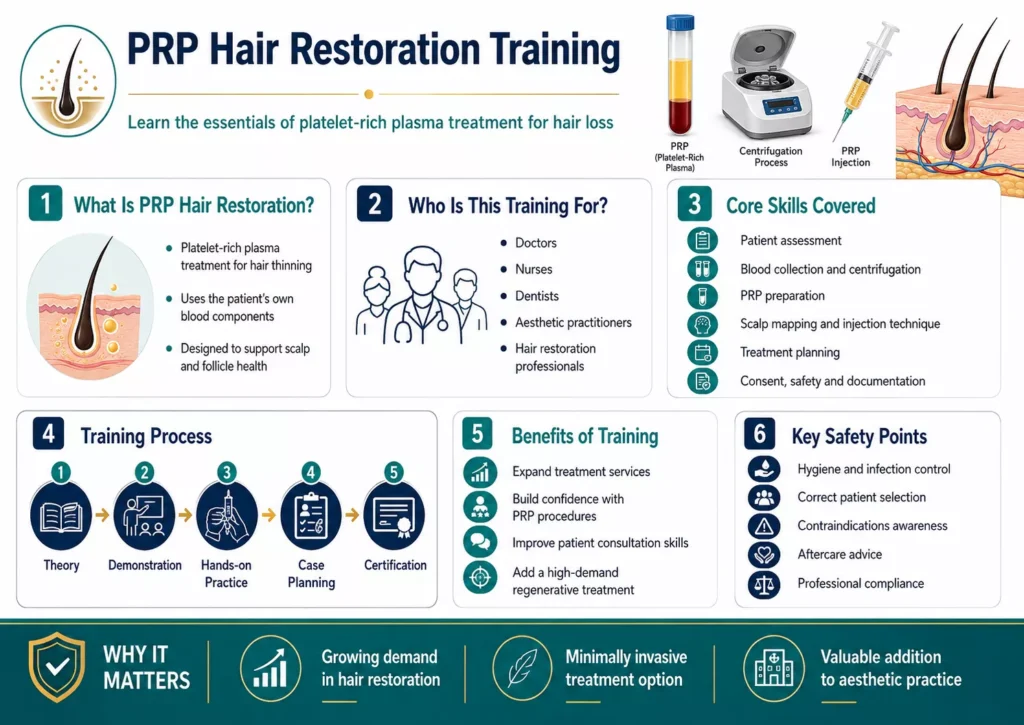
PRP hair training teaches practitioners how to assess hair loss, select suitable patients, prepare platelet-rich plasma safely, handle blood and centrifugation equipment, plan scalp treatment areas, use appropriate PRP delivery techniques, maintain infection control, gain informed consent, manage complications and provide aftercare. A comprehensive course should also develop knowledge of hair and scalp anatomy, androgenetic alopecia, the hair growth cycle, platelet biology, treatment planning, clinical photography, record keeping and realistic patient communication. The aim is not simply to learn how to deliver PRP. Good training develops the clinical judgement needed to decide who may benefit from treatment, who should not be treated and when referral to another healthcare professional is more appropriate.
What Skills Do You Learn in PRP Hair Training?
PRP hair training combines theoretical knowledge with practical clinical skills. Platelet-rich plasma, commonly shortened to PRP, is prepared from a patient’s own blood and contains a concentrated proportion of platelets. These platelets contain biologically active proteins and growth factors involved in tissue repair and cellular signalling.
Within hair restoration, PRP is commonly discussed in relation to androgenetic alopecia, also called male or female pattern hair loss. Research remains active, but recent evidence suggests PRP can improve hair density in some people with alopecia, while variations in preparation methods and treatment protocols can influence outcomes.
For that reason, professional PRP education should cover far more than the physical treatment itself.
A well-rounded course generally develops skills in:
- Hair and scalp anatomy
- Understanding the hair growth cycle
- Recognising common forms of hair loss
- Patient consultation and medical history taking
- Hair and scalp assessment
- Patient suitability and contraindication screening
- Blood collection and safe blood handling
- PRP preparation and centrifugation principles
- Infection prevention and aseptic practice
- Scalp treatment planning
- PRP administration principles
- Patient comfort and pain management
- Complication recognition and management
- Consent and clinical documentation
- Before-and-after photography
- Aftercare and follow-up
- Treatment planning and outcome assessment
- Managing expectations and communicating evidence
These skills work together. Being technically able to prepare PRP does not by itself make someone competent to provide safe and appropriate hair restoration treatment.
1. Understanding Hair and Scalp Anatomy
One of the first skills developed during PRP hair restoration training is understanding the structure of the scalp and hair follicle. Practitioners need to understand what lies beneath the visible hair because PRP treatment is performed within living scalp tissue rather than simply on its surface.
Training may therefore cover important anatomical entities such as the:
- Epidermis
- Dermis
- Subcutaneous tissue
- Hair shaft
- Hair follicle
- Hair bulb
- Dermal papilla
- Sebaceous gland
- Blood vessels
- Nerve structures
Understanding these structures helps practitioners assess treatment areas and appreciate how the hair follicle receives nutrients and biological signals.
It also supports safer clinical decision-making. Rather than treating every area of thinning hair in the same way, trained practitioners learn to consider scalp anatomy, hair distribution and the underlying pattern of hair loss.
2. Learning the Hair Growth Cycle
PRP hair training also teaches the biological cycle through which human hair grows, rests and sheds. The main stages are commonly described as anagen, catagen and telogen, followed by shedding and renewal. The anagen phase is the active growth period, while telogen represents a resting stage before hair is eventually shed. Understanding this cycle is important because hair restoration does not normally produce an immediate visible transformation.
A practitioner needs to explain why:
- New growth takes time.
- Hair density changes gradually.
- Several treatment sessions may be considered.
- Results vary between individuals.
- Follow-up photographs need to be taken over meaningful time periods.
This biological understanding also helps practitioners separate realistic clinical outcomes from exaggerated claims.
That matters because professional standards for cosmetic interventions emphasise giving patients accurate information about expected outcomes, benefits and risks rather than creating unrealistic expectations.
3. Recognising Different Types of Hair Loss
Another major skill is learning that hair loss is a symptom with many possible causes. Not every person experiencing thinning hair is automatically an appropriate candidate for PRP.
Training should introduce conditions such as:
- Androgenetic alopecia
- Male pattern hair loss
- Female pattern hair loss
- Telogen effluvium
- Alopecia areata
- Traction alopecia
- Scarring alopecia
- Hair loss linked to nutritional or medical problems
The practitioner does not simply ask, “Is the patient’s hair thinning?”
A more useful clinical question is:
Why is the hair thinning?
For example, patterned thinning developing gradually over several years presents a different clinical picture from sudden widespread shedding or an inflamed, painful scalp.
Knowing these differences helps practitioners understand when PRP may be considered and when further medical investigation or specialist referral may be more appropriate.
4. Performing a Professional Hair-Loss Consultation
Consultation skills form a central part of high-quality PRP hair training. The consultation is where the practitioner gathers information, examines the patient’s concerns and determines whether treatment is appropriate.
A thorough consultation may explore:
- When the hair loss started
- How quickly it has progressed
- Areas affected by thinning
- Previous hair-loss treatments
- Relevant medical history
- Current medicines
- Allergies
- Previous procedures
- Lifestyle factors
- Family history of pattern hair loss
- Expectations from PRP treatment
Practitioners should also learn how to listen carefully to what the patient actually wants.
For medical professionals covered by GMC cosmetic-intervention guidance, this includes considering medical history, asking why the patient wants treatment and discussing whether the proposed intervention is likely to meet their needs.
This makes consultation a clinical skill rather than a sales process.
5. Assessing the Hair and Scalp
Following the consultation, practitioners learn how to perform a structured hair and scalp assessment. This means examining more than the number of visible hairs.
Assessment may consider:
- Hair density
- Distribution of thinning
- Hairline pattern
- Crown involvement
- Scalp condition
- Evidence of inflammation
- Signs of scarring
- Areas of miniaturisation
- Progression of hair loss
- Differences between treatment zones
Pattern-recognition skills are particularly valuable when dealing with androgenetic alopecia. Male pattern hair loss, for example, often follows recognisable patterns around the temples, frontal scalp and crown, while female pattern hair loss may present with more diffuse thinning. A good course should teach trainees to document what they see before developing a treatment plan.
6. Selecting Suitable PRP Hair Patients
One of the most valuable skills learned in PRP training is knowing when not to perform treatment. Patient selection influences both safety and treatment satisfaction. During training, practitioners should learn how to identify factors that may affect suitability, including relevant medical conditions, active scalp problems, medication history and possible contraindications.
The exact decision must depend on the practitioner’s professional scope, patient circumstances and applicable clinical guidance. This prevents a common mistake in aesthetic practice: assuming that someone requesting a treatment must automatically be suitable for it. Competent practitioners should be prepared to postpone treatment, request additional information or refer the patient when the clinical picture falls outside their competence.
The GMC similarly requires registered professionals offering cosmetic interventions to recognise the limits of their competence and refer when they cannot safely meet a patient’s needs.
7. Developing Phlebotomy and Blood-Handling Skills
Because PRP is produced from the patient’s own blood, blood collection and handling are fundamental parts of practical PRP education. Depending on the course and the learner’s existing professional background, training may include or require competence in venepuncture.
Learners need to understand:
- Safe blood collection principles
- Appropriate blood-handling procedures
- Infection-control precautions
- Sharps safety
- Correct specimen handling
- Clinical waste management
- Maintaining an organised treatment environment
PRP is described as an autologous treatment, meaning the biological material comes from the same patient receiving it.
Although this can reduce some risks associated with donor-derived materials, blood handling remains a clinical procedure requiring careful infection prevention and safe working practices.
A PRP certificate should therefore never be treated as a substitute for any separate phlebotomy competency required by the practitioner, employer, insurer or professional regulator.
8. Understanding PRP Preparation and Centrifugation
A core technical element of PRP hair training is learning how platelet-rich plasma is prepared. After blood collection, specialised centrifugation is used to separate different components according to their physical properties.
Rather than simply teaching learners to press buttons on a centrifuge, good PRP education explains concepts such as:
- Whole blood
- Plasma
- Platelets
- Red blood cells
- Platelet concentration
- Centrifugation
- Separation systems
- PRP preparation kits
- Single-spin and multi-spin concepts
- Platelet activation
- Protocol consistency
Understanding these principles matters because PRP is not a single perfectly standardised product.
Research continues to show considerable variation between PRP preparation methods, platelet concentrations, activation approaches and administration protocols. This heterogeneity is one reason researchers continue to call for better standardisation in PRP hair-loss treatment.
Good training therefore teaches practitioners to understand and follow the validated protocol for the system they are using.
9. Maintaining Aseptic Technique and Infection Control
PRP treatment involves blood handling and an invasive procedure, making infection prevention an essential competency. Students should learn how to create and maintain a clean clinical environment throughout the patient journey.
Training commonly reinforces principles involving:
- Hand hygiene
- Personal protective equipment
- Skin preparation
- Clean treatment surfaces
- Sterile or single-use equipment where required
- Sharps disposal
- Cross-contamination prevention
- Clinical waste
- Safe equipment handling
These habits must become routine rather than something remembered only during an assessment. A technically successful PRP preparation means little if poor infection-control practices expose the patient or practitioner to avoidable risk.
10. Planning the Scalp Treatment Area
PRP hair restoration is not simply about identifying “where the hair looks thin”. Training helps practitioners develop scalp mapping and treatment-planning skills.
A treatment plan may take account of:
- The patient’s hair-loss pattern
- Areas of active thinning
- Existing hair density
- Previous treatments
- Hairline characteristics
- Crown involvement
- Baseline photographs
- Treatment objectives
The practitioner should be able to explain why a particular area is being addressed and what outcome can reasonably be expected. This creates a more personalised approach than applying exactly the same pattern to every patient.
11. Learning Safe PRP Delivery Principles
Hands-on training normally introduces the clinical principles involved in delivering PRP into the planned scalp area. This is where supervised practical education becomes particularly important.
Rather than relying on videos or written instructions alone, learners benefit from understanding:
- Clinical positioning
- Safe handling of equipment
- Scalp treatment patterns
- Consistent delivery
- Patient observation
- Comfort during treatment
- Appropriate clinical endpoints
- When to stop or reassess
The exact method used can differ between treatment systems, practitioners and clinical protocols.
For this reason, online theory alone should not be assumed to demonstrate practical competence. For professionals subject to GMC standards, training or supervised practice is specifically highlighted before carrying out an intervention for the first time.
12. Managing Patient Comfort
PRP treatment can involve discomfort, so practitioners also learn how to manage the patient’s experience professionally. This starts before the procedure. A calm explanation of what the patient may feel can reduce uncertainty and improve cooperation.
Useful communication skills include:
- Explaining expected sensations
- Checking comfort throughout treatment
- Watching for anxiety
- Recognising signs of distress
- Allowing appropriate breaks
- Explaining normal short-term reactions
Clinical competence involves both performing a procedure and responding appropriately to the person receiving it. A practitioner who communicates clearly can often create a much more controlled and reassuring treatment experience.
13. Recognising and Managing Complications
PRP is often described as minimally invasive, but minimally invasive does not mean risk-free. Training should therefore teach practitioners how to recognise expected reactions and distinguish them from potential complications. Published studies commonly report short-term reactions such as localised discomfort, redness, bleeding or irritation, although the overall evidence base and treatment protocols remain heterogeneous.
A competent practitioner should understand:
- Normal post-treatment reactions
- Unexpected reactions
- Infection warning signs
- Bleeding concerns
- Vasovagal reactions associated with blood collection
- When treatment should be stopped
- When medical assessment or referral is required
- How adverse events should be documented
Complication management should be taught alongside technique, not treated as an optional extra. Professional guidance also expects practitioners to provide patients with information about how to report complications and adverse reactions.
14. Obtaining Informed Consent
PRP hair training should develop the ability to obtain meaningful informed consent, not simply a signature on a form. Before treatment, patients should understand the purpose of the procedure and have an opportunity to consider relevant information.
That discussion may include:
- What PRP involves
- Why treatment is being considered
- Expected benefits
- Important limitations
- Potential risks
- Alternative options
- Expected recovery
- Likely treatment course
- Costs
- The possibility of limited or no visible improvement
For medical professionals regulated by the GMC, consent is regarded as a fundamental part of cosmetic practice. Patients must receive enough information and time to make a voluntary, informed decision. Good consent therefore supports shared decision-making rather than merely protecting the clinic administratively.
15. Setting Realistic Patient Expectations
Expectation management is one of the most underestimated PRP hair treatment skills. Hair restoration patients may arrive after seeing dramatic before-and-after images online. Some expect PRP to restore a completely bald area or provide rapid regrowth.
Good practitioners learn to explain what the evidence actually supports. A 2025 systematic review and meta-analysis covering 43 randomised controlled trials reported moderate evidence that PRP can improve hair density and reduce hair loss in alopecia, while also noting protocol differences and the need for further standardised research.
This supports careful language such as:
“PRP may improve hair density in suitable patients.”
It does not justify promises such as:
“PRP will regrow all of your lost hair.”
Being able to communicate that distinction is a genuine clinical skill.
16. Creating Individual Treatment Plans
PRP training also develops treatment-planning skills. Patients differ in age, hair-loss pattern, medical background, treatment history and goals. As a result, a professional plan should be based on individual assessment rather than a one-size-fits-all package.
Treatment planning may include consideration of:
| Area | What the Practitioner Considers |
|---|---|
| Hair-loss pattern | Location and progression of thinning |
| Suitability | Medical history and clinical assessment |
| Baseline | Hair density and clinical photographs |
| Treatment objective | Realistic improvement being targeted |
| Review | How progress will be assessed |
| Follow-up | When reassessment is appropriate |
| Referral | Whether another professional should be involved |
The practitioner should also recognise when PRP should form only one part of a broader hair-loss management strategy.
17. Taking Standardised Clinical Photographs
Photography is another practical skill commonly included in professional hair-restoration education. Hair growth changes can be subtle, and memory is unreliable. Standardised photographs make it easier to compare the scalp over time.
Practitioners learn to keep factors such as the following as consistent as reasonably possible:
- Lighting
- Camera position
- Patient position
- Hair direction
- Treatment area
- Image distance
- Background
Photography must also be handled with appropriate patient consent, confidentiality and data protection. Good photographs support clinical assessment. They should not be manipulated or selectively presented in a way that creates misleading expectations.
18. Keeping Accurate Clinical Records
Every PRP treatment should leave a clear clinical record.
Record-keeping skills may include documenting:
- Consultation findings
- Relevant medical history
- Hair-loss assessment
- Consent
- Treatment rationale
- Products and equipment used
- Treatment areas
- Patient tolerance
- Adverse events
- Aftercare advice
- Follow-up
- Clinical photography
Strong documentation supports continuity of care and makes it easier to evaluate outcomes over time. It can also show the reasoning behind decisions if questions arise later. For regulated healthcare professionals, documentation forms part of broader professional accountability and patient safety.
19. Providing PRP Hair Treatment Aftercare
The patient’s care does not finish when the procedure ends. Practitioners should learn how to provide clear PRP hair aftercare instructions.
Patients may need information about:
- Expected short-term scalp reactions
- Hair and scalp care
- Activities that may need temporary modification
- When usual routines can resume
- Warning signs that require clinical advice
- Who to contact if they are concerned
- When follow-up is expected
Aftercare should be easy to understand and preferably supported by suitable written information. GMC guidance similarly emphasises giving cosmetic patients relevant information that supports continuity of care and tells them how to report complications.
20. Monitoring PRP Hair Treatment Results
PRP training should also teach practitioners how to evaluate outcomes objectively. Looking at a patient’s hair immediately after treatment tells very little about effectiveness.
Practitioners may instead compare:
- Baseline photographs
- Follow-up photographs
- Hair density
- Pattern progression
- Patient-reported changes
- Treatment tolerance
- Satisfaction
- Adverse reactions
Monitoring outcomes also improves professional practice. If results repeatedly fall below expectations, competent practitioners should review their patient selection, treatment protocols, documentation and clinical approach rather than simply continuing the same process. This evidence-based mindset is important because the scientific literature still shows variation between PRP protocols and study results.
21. Understanding PRP Alongside Other Hair-Loss Treatments
Hair-loss education should give practitioners enough knowledge to understand where PRP fits within the wider treatment landscape.
Depending on the diagnosis and the professional scope of the practitioner, patients may encounter options such as:
- Minoxidil
- Finasteride
- Hair transplantation
- Microneedling
- Low-level light or laser approaches
- Medical investigation
- Nutritional assessment
- Dermatology referral
- Scalp-condition treatment
Research has also explored PRP in combination with other therapies, including minoxidil, although treatment decisions should be based on an appropriate clinical assessment and the practitioner’s professional competence. The key skill is not learning to provide every possible therapy. It is recognising the limitations of PRP and understanding when another approach may better serve the patient.
What Practical Skills Should a PRP Hair Course Include?
A strong course should combine theoretical understanding with supervised practical learning appropriate to the learner’s existing qualifications and professional scope.
Important practical competencies commonly include:
- Conducting a structured patient consultation.
- Reviewing relevant medical history.
- Assessing hair and scalp presentation.
- Identifying suitable and unsuitable treatment candidates.
- Applying infection-control principles.
- Handling blood safely.
- Understanding the chosen PRP preparation system.
- Using centrifugation equipment correctly according to the validated system protocol.
- Planning treatment areas.
- Applying safe PRP delivery principles.
- Communicating with the patient throughout treatment.
- Recognising potential complications.
- Providing appropriate aftercare.
- Recording treatment accurately.
- Reviewing results through follow-up assessment and photography.
A certificate should represent education completed; it should not be interpreted as automatically granting a practitioner permission to perform every aspect of PRP treatment.
Clinical Knowledge vs Practical Skills in PRP Training
Both areas are necessary.
| Clinical Knowledge | Practical Skills |
|---|---|
| Hair anatomy | Patient positioning |
| Hair growth cycle | Clinical assessment |
| Types of alopecia | Blood handling |
| Platelet biology | PRP preparation |
| Patient selection | Equipment handling |
| Contraindications | Infection prevention |
| Risks and complications | Treatment-area planning |
| Evidence and outcomes | Patient communication |
| Consent principles | Clinical documentation |
| Treatment planning | Aftercare delivery |
Clinical theory answers why something should be done. Practical training develops the ability to perform relevant tasks safely and consistently. Competence requires both.
Why Patient Assessment Is One of the Most Important PRP Skills
The quality of a PRP treatment begins before any blood is collected. Suppose two patients both have visibly thinning hair. One has gradually progressing hereditary pattern hair loss. The other developed sudden hair shedding over several weeks following an unexplained health change. They may look similar at first glance, but they do not necessarily require the same response.
A trained practitioner recognises this. The ability to assess, question, identify uncertainty and refer when necessary may be more important for patient safety than the ability to operate a centrifuge. This is why comprehensive PRP hair training should teach clinical judgement alongside technical skills.
Does PRP Hair Training Teach You How to Treat Every Type of Hair Loss?
No. PRP training should actually teach the opposite: not every type of hair loss should automatically be treated with PRP. Hair loss may result from genetic, hormonal, inflammatory, autoimmune, nutritional, medical, mechanical or medication-related factors.
A practitioner’s responsibility is therefore to recognise whether the presentation falls within their competence. Where the cause is unclear, where concerning signs are present or where another diagnosis is suspected, referral for appropriate medical assessment may be required. This boundary-setting is part of professional competence.
Is Hands-On Practice Important in PRP Hair Training?
Yes. Practical supervised experience is particularly valuable because PRP treatment combines several physical competencies, including blood handling, equipment use, infection control, patient management and clinical treatment skills. Watching a demonstration can explain a process.
Performing the relevant skills under appropriate supervision allows learners to receive feedback on how they actually work. For GMC-regulated practitioners, current professional guidance specifically states that professionals should ensure they can carry out an intervention safely before performing it for the first time, for example through training or supervised practice.
What Should You Be Able to Do After PRP Hair Training?
After suitable education, practical training and competency assessment, a learner should have a clearer understanding of how to manage the complete PRP hair-treatment pathway within their authorised professional scope.
That means being able to move logically through:
Consultation → assessment → patient selection → consent → preparation → treatment → aftercare → documentation → follow-up.
The most important outcome is not simply being able to say:
“I know how to perform PRP.”
It is being able to say:
“I understand how to assess whether PRP is appropriate, explain it accurately, work safely within my competence and manage the patient throughout the treatment journey.”
What Makes Good PRP Hair Training?
Quality PRP training should build both knowledge and clinical judgement.
When evaluating training, learners should look for education covering:
- Hair and scalp science
- Hair-loss assessment
- PRP science and platelet biology
- Patient suitability
- Contraindications
- Blood handling
- PRP preparation systems
- Infection prevention
- Treatment planning
- Supervised practical experience
- Complications
- Consent
- Documentation
- Photography
- Aftercare
- Follow-up and outcome assessment
The training provider should also make clear any prerequisites and should not suggest that completing a short course automatically overrides professional, regulatory, insurance or workplace requirements.
Why These Skills Matter for Safe PRP Hair Restoration
PRP sits at the intersection of hair restoration, regenerative medicine, phlebotomy and aesthetic practice. That makes the quality of practitioner education important. The scientific literature suggests that PRP can have a positive effect on hair density in selected alopecia patients, but research also shows substantial differences between PRP formulations and treatment protocols.
At the same time, professional standards emphasise competence, informed consent, evidence-based treatment, patient safety and realistic communication. Effective training therefore connects scientific knowledge with practical skills and ethical clinical judgement.
Final Thought
PRP hair training develops much more than the technical ability to prepare and administer platelet-rich plasma. It teaches practitioners how to understand hair biology, recognise common patterns of hair loss, assess patients, identify contraindications, handle blood safely, understand centrifugation, maintain aseptic practice, plan treatment areas and manage the patient throughout the procedure.
Equally important are the less visible skills: obtaining informed consent, setting realistic expectations, recognising complications, taking standardised photographs, maintaining accurate records, providing aftercare and knowing when to refer. Together, these competencies turn PRP from a procedure into a structured clinical treatment pathway.
For anyone considering PRP hair restoration training, the strongest course is therefore not simply the one that teaches how PRP is delivered. It is the one that develops the scientific understanding, hands-on ability, patient-safety awareness and professional judgement required to use PRP responsibly within the practitioner’s appropriate scope of practice.
FAQs
What is the main skill learned in PRP hair training?
The central skill is managing the complete PRP hair-restoration process safely, from patient assessment and suitability screening to PRP preparation, treatment, aftercare and follow-up.
Do you learn phlebotomy during PRP hair training?
Some courses include venepuncture training, while others require learners to hold existing phlebotomy competence. Always check the entry requirements and practical scope of the specific course.
Do you learn how to use a centrifuge?
Yes. PRP education commonly covers centrifugation principles, blood-component separation and use of the PRP preparation system employed during training.
Does PRP training teach hair-loss diagnosis?
Training should help practitioners recognise common hair-loss patterns and identify presentations requiring further assessment. Formal diagnosis must remain within the practitioner’s professional competence and scope of practice.
Do you learn PRP injection skills during the course?
Hands-on courses normally teach relevant scalp PRP delivery principles and treatment-area planning under appropriate supervision. Practical competency is preferable to relying solely on online theory.
Will I learn how to assess PRP patients?
Yes. Patient assessment should be one of the core elements of comprehensive training, including medical history, scalp assessment, suitability, expectations and possible contraindications.
Does PRP hair training cover complications?
A suitable course should cover expected reactions, potential complications, infection control, adverse-event recognition and the circumstances in which further medical assessment or referral is needed.
Will I learn about androgenetic alopecia?
Yes. Male and female pattern hair loss, collectively associated with androgenetic alopecia, are important topics because they frequently arise in the context of PRP hair-restoration treatment.
Does a PRP certificate mean I can immediately offer treatment?
Not necessarily. Course completion does not replace applicable professional scope-of-practice rules, insurance requirements, employer policies, regulatory obligations or any additional competency requirements.
Is PRP proven to regrow hair?
Evidence suggests PRP may improve hair density and reduce hair loss in some patients, particularly in certain forms of alopecia, but results vary and treatment protocols are not fully standardised. It should not be presented as guaranteed hair regrowth.
Why is consultation training important for PRP practitioners?
A consultation helps determine why the patient is losing hair, whether PRP may be appropriate, whether expectations are realistic and whether further medical assessment should be recommended.
How long does it take to become competent in PRP hair treatment?
There is no universal period that guarantees competence. It depends on previous clinical experience, course quality, supervised practice, assessment and the requirements of the practitioner’s professional role.