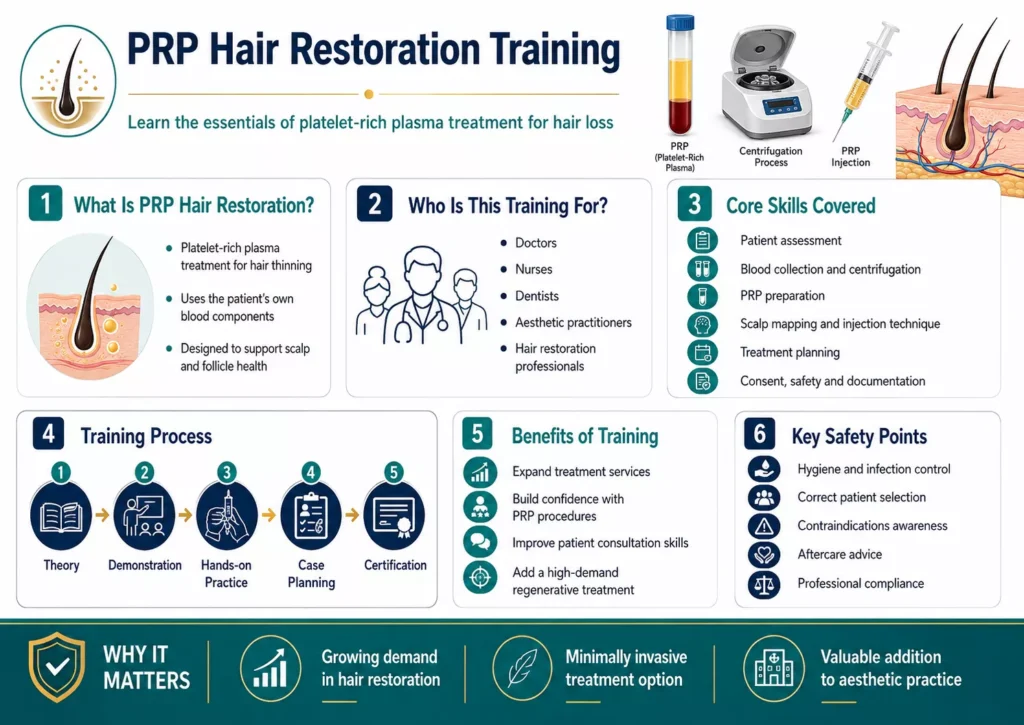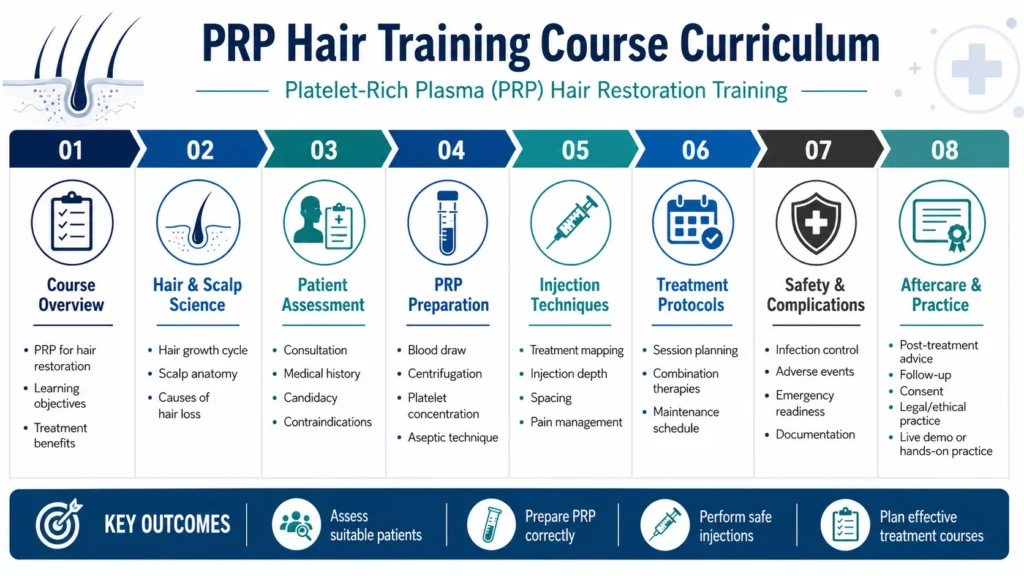
A comprehensive PRP hair training course curriculum in the UK typically covers platelet-rich plasma science, hair and scalp anatomy, common causes of hair loss, patient consultation and selection, contraindications, venepuncture, blood handling, centrifugation, PRP preparation, scalp injection techniques, infection prevention, complications, aftercare, consent, clinical documentation and supervised practical training. UK practitioners should also learn about professional scope of practice, indemnity insurance, local-authority requirements and relevant regulatory considerations before offering PRP hair treatments.
Learning to perform platelet-rich plasma treatment for hair loss involves much more than drawing blood, placing a tube in a centrifuge and injecting plasma into the scalp.
A good PRP hair training course should teach you three things at the same time:
- Why a patient is losing their hair
- How PRP is prepared and administered
- How to provide the treatment safely and appropriately within UK professional and regulatory requirements
That first point is particularly important. A person experiencing thinning hair may have androgenetic alopecia, temporary shedding, alopecia areata, an underlying health condition or another scalp or hair disorder. The NHS advises that some hair loss is temporary or related to medical conditions, and that no hair-loss treatment is completely effective for everybody.
So, simply knowing how to inject PRP is not enough. A practitioner also needs to understand patient assessment, treatment limitations, referral and realistic expectations.
What Is Included in a PRP Hair Training Course Curriculum?
Although the exact syllabus varies between UK training providers, a comprehensive programme commonly moves from theory and patient assessment through to PRP preparation and supervised practical treatment.
A typical curriculum may include:
| Curriculum Area | What You Learn |
|---|---|
| PRP science | Platelets, plasma, blood components and growth factors |
| Hair and scalp anatomy | Hair follicles, scalp structure and hair-growth cycles |
| Hair-loss conditions | Common forms and patterns of alopecia |
| Consultation | Medical history, expectations and treatment planning |
| Patient selection | Suitability, contraindications and referral |
| Venepuncture | Safe blood collection where included in the course |
| Infection prevention | Aseptic technique, PPE, sharps and clinical waste |
| PRP preparation | Centrifugation and plasma separation |
| Scalp assessment | Mapping areas of thinning and treatment planning |
| Injection technique | Depth, spacing, distribution and needle control |
| Complications | Recognition, management and escalation |
| Aftercare | Post-treatment advice and follow-up |
| Consent | Informed consent and managing expectations |
| Documentation | Clinical notes, photography and treatment records |
| UK professional requirements | Scope of practice, insurance and regulatory considerations |
| Practical assessment | Supervised treatment and competency evaluation |
The most important distinction is this:
PRP training should teach clinical decision-making, not simply treatment mechanics.
Module 1: Understanding Platelet-Rich Plasma
Most PRP courses begin with the science behind platelet-rich plasma, commonly shortened to PRP. PRP is an autologous preparation, meaning it is produced from the patient’s own blood. Blood is collected and processed so that a plasma fraction containing platelets can be prepared for treatment.
Training may cover:
- whole blood
- plasma
- red blood cells
- white blood cells
- platelets
- platelet concentration
- growth factors
- anticoagulants
- platelet activation
- platelet-rich plasma
- platelet-poor plasma
- autologous treatment
Rather than simply memorising a treatment sequence, learners should understand what happens to the blood during preparation and why different PRP systems may produce different final preparations.
Why Does PRP Science Matter?
Different preparation methods can affect the characteristics of the resulting PRP.
For example, learners may encounter differences involving:
- platelet concentration
- leukocyte concentration
- volume of plasma produced
- centrifugation protocol
- collection tubes
- activation methods
A quality curriculum should therefore discourage the idea that every PRP kit or centrifuge works in exactly the same way.
Module 2: Hair and Scalp Anatomy
Before injecting the scalp, practitioners need a clear understanding of the anatomy beneath it.
A PRP hair course may therefore cover structures including:
- epidermis
- dermis
- subcutaneous tissues
- blood vessels
- nerves
- hair shafts
- hair follicles
- sebaceous glands
- dermal papilla
- follicular units
Understanding these structures helps provide context for treatment depth, scalp assessment and safe injection technique.
Module 3: Understanding the Hair-Growth Cycle
Hair does not grow continuously at the same rate. Individual follicles move through different stages of growth and rest. Students will usually learn about three key phases.
Anagen Phase
Anagen is the active growth stage. Hair follicles may remain in this phase for a considerable period while the hair shaft continues to grow.
Catagen Phase
Catagen is a short transitional stage during which active growth slows, and the follicle begins changing.
Telogen Phase
Telogen is the resting stage. After this phase, the existing hair can shed before the follicle begins another cycle.
Understanding the hair-growth cycle is useful when discussing treatment expectations because visible changes in hair density are not immediate.
Module 4: Recognising Different Types of Hair Loss
One of the most valuable parts of a PRP hair training curriculum is learning that hair loss is not a single condition.
A patient may simply say:
“My hair is getting thinner.”
But the underlying cause still needs consideration.
Training may introduce conditions and presentations such as:
- androgenetic alopecia
- male pattern hair loss
- female pattern hair loss
- telogen effluvium
- alopecia areata
- traction alopecia
- scarring alopecia
- inflammatory scalp disorders
- diffuse hair shedding
The NHS advises people who are concerned about hair loss to understand the cause before considering treatment and notes that hair loss associated with certain medical conditions may improve when the underlying condition resolves.
Why Is This Important for PRP Practitioners?
Because not every person with hair loss should automatically receive PRP. Practitioners should learn when a presentation appears appropriate for treatment within their competence and when further medical assessment or referral may be needed. A PRP course does not turn somebody into a dermatologist. Good training should make that limitation clear.
Module 5: Androgenetic Alopecia and Pattern Hair Loss
Androgenetic alopecia is an important entity within PRP hair-restoration education because male and female pattern hair loss are common reasons people seek private hair-loss treatments.
Training may explore:
- typical patterns of thinning
- progressive follicular miniaturisation
- family history
- changes in hair density
- differences between male and female presentations
- treatment objectives
- realistic expectations
The NHS identifies finasteride and minoxidil as the main treatments for male pattern baldness and states that minoxidil may also be used for female pattern baldness. It also stresses that treatments do not work for everybody.
For PRP trainees, that reinforces an important principle:
PRP should be understood within the wider hair-loss treatment landscape rather than presented as a guaranteed cure.
Module 6: Conducting a PRP Hair Consultation
Technical ability starts with the needle. Clinical judgement starts with the consultation. Before treating someone, practitioners should gather enough relevant information to make an appropriate treatment decision.
A consultation may include:
- the patient’s main concern
- when the hair loss started
- whether it developed suddenly or gradually
- pattern of thinning
- excessive shedding
- family history
- previous diagnoses
- medicines
- relevant medical history
- previous hair treatments
- scalp symptoms
- previous procedures
- expectations
- treatment goals
The course should also teach practitioners to recognise information that may require further assessment.
Module 7: Scalp and Hair Assessment
A specialised PRP hair course should go beyond taking a medical history.
Students may also learn how to assess:
- location of thinning
- hair density
- pattern of hair loss
- scalp condition
- inflammation
- signs of active scalp disease
- areas appropriate for treatment
- changes between appointments
Some training programmes may introduce tools such as dermoscopy or trichoscopy, although the level of diagnostic training provided will vary. The goal is not to encourage practitioners to diagnose conditions beyond their professional competence.
Instead, they should know when something does not fit the expected presentation and when referral is appropriate.
Module 8: Clinical Photography
Hair restoration develops gradually, so photographs can play an important role in monitoring treatment.
Students may learn how to produce consistent before-and-after photographs using the same:
- lighting
- background
- camera position
- patient position
- hair preparation
- scalp angle
- distance
Consent for clinical photography should also be addressed. Importantly, consent to take photographs for the patient’s clinical record is not automatically the same as permission to use those photographs for advertising, websites or social media.
Module 9: Patient Selection for PRP Hair Treatment
A good practitioner should be able to decide not to treat. That is why patient selection deserves its own module.
Training should explain how factors such as the following may affect treatment decisions:
- type of hair loss
- medical history
- scalp health
- current medicines
- previous procedures
- bleeding or clotting concerns
- infection
- unrealistic expectations
- treatment history
- ability to follow aftercare
Some patients may appear suitable. Others may require additional medical assessment. And some may not be appropriate candidates for PRP at all. A reputable curriculum teaches learners to recognise the difference.
Module 10: Contraindications, Precautions and Referral
PRP involves venepuncture, blood processing and injections. Contraindication screening should therefore be a central part of training rather than an afterthought.
A course should explain how to identify:
- situations in which treatment should be postponed
- circumstances requiring further medical information
- conditions outside the practitioner’s competence
- potential blood-related concerns
- local infection or scalp conditions
- medicine-related considerations
- situations requiring referral
Exact contraindications should follow the relevant clinical protocol, product or system instructions, professional guidance and the practitioner’s scope of practice. Students should also understand that a signed consent form does not make an unsuitable treatment appropriate.
Module 11: Venepuncture and Blood Collection
Every PRP treatment begins with blood collection. For that reason, venepuncture competence is an important part of PRP practice.
Depending on the provider, a UK PRP training course may:
- include venepuncture training
- require prior phlebotomy competence
- accept particular healthcare qualifications
- require learners to complete separate venepuncture training
Training may include:
- patient identification
- equipment preparation
- selecting an appropriate vein
- tourniquet use
- venepuncture
- collecting the required blood volume
- tube handling
- sharps safety
- unsuccessful blood draws
- vasovagal reactions
- clinical waste disposal
Prospective students should check the provider’s entry requirements before booking.
Module 12: Infection Prevention and Control
PRP involves handling human blood and creating multiple potential points of skin penetration. A strong course should therefore place infection prevention and aseptic practice at the centre of the procedure.
Students may learn about:
- hand hygiene
- personal protective equipment
- preparation of treatment surfaces
- single-use equipment
- aseptic technique
- contamination prevention
- sharps management
- blood spill procedures
- clinical waste
- treatment-room hygiene
- equipment decontamination
The Joint Council for Cosmetic Practitioners (JCCP) publishes UK resources covering PRP in aesthetic procedures alongside wider premises and practitioner standards.
Module 13: Centrifugation and PRP Preparation
This is where the patient’s blood becomes the PRP preparation intended for treatment.
Training may cover:
- PRP collection tubes
- anticoagulants
- centrifuge loading
- balanced centrifuge placement
- spin duration
- relative centrifugal force (RCF)
- revolutions per minute (RPM)
- separation of blood components
- collection of the required plasma fraction
- platelet-poor plasma
- red-cell contamination
- leukocyte-rich and leukocyte-poor concepts
Is There One Correct PRP Centrifuge Setting?
No single setting should be copied across every system.
Different validated PRP preparation systems may use different:
- tubes
- centrifuges
- spin times
- centrifugal forces
- processing steps
Training should therefore teach students how to follow the specific manufacturer’s protocol and standard operating procedure (SOP) used by their clinic.
Module 14: PRP Equipment and Consumables
Learners should become familiar with the equipment involved in delivering treatment safely.
This may include:
- blood collection equipment
- PRP tubes or kits
- centrifuge
- syringes
- needles
- sterile consumables
- gloves and PPE
- sharps containers
- clinical waste containers
- cleansing products
- treatment trays
The curriculum should also discuss equipment storage, preparation and traceability where relevant.
Module 15: Preparing and Mapping the Scalp
Before injecting PRP, the practitioner needs a treatment plan.
Students may learn how to:
- identify areas of thinning
- divide the scalp into treatment zones
- prepare the scalp
- maintain aseptic technique
- plan injection points
- consider treatment distribution
- position the patient correctly
The treatment map should reflect the patient’s presentation rather than using the exact same pattern for every person.
Module 16: PRP Scalp Injection Techniques
Hands-on injection training is typically one of the most important practical components.
Students may learn about:
- needle selection
- syringe control
- injection angle
- treatment depth
- injection spacing
- volume distribution
- scalp mapping
- safe needle handling
- patient positioning
- communication during treatment
Exact techniques and protocols may vary between training providers and PRP systems. The important part is supervised competency. Watching somebody inject a scalp on a video is not the same as receiving feedback on your own hand position, needle control, patient communication and clinical technique.
Module 17: Patient Comfort and Pain Management
PRP scalp injections can cause discomfort. Training should therefore discuss practical ways to maintain patient comfort while keeping treatment safe.
This may include:
- preparing the patient for the sensation
- appropriate positioning
- treatment pacing
- cooling where appropriate
- permitted topical anaesthetic approaches
- monitoring patient response
- stopping treatment when necessary
Any medicines or anaesthetic products must be used only where appropriate and within the practitioner’s professional scope.
Module 18: Designing a PRP Hair Treatment Plan
Patients frequently want a simple answer to one question:
How many PRP sessions will I need?
A responsible course should avoid presenting one schedule as a guaranteed protocol for everybody.
Treatment planning may consider:
- cause of hair loss
- degree of thinning
- baseline hair density
- treatment objectives
- response to previous sessions
- PRP system used
- clinic protocol
- available evidence
- practitioner judgement
Patients also need to understand that hair growth occurs gradually. PRP hair restoration is not comparable to an instant cosmetic treatment where the result can be judged as soon as the patient leaves the clinic.
Module 19: PRP Alongside Other Hair-Loss Treatments
Hair-loss management often involves more than one possible approach.
A curriculum may introduce how PRP fits alongside options such as:
- minoxidil
- finasteride where medically appropriate
- hair transplantation
- microneedling
- low-level light or laser treatments
- scalp treatments
- management of underlying medical conditions
The NHS lists minoxidil and finasteride among established treatments for pattern hair loss while also stressing that treatments do not work for everyone. A PRP practitioner should therefore understand that their treatment is part of a broader hair-restoration landscape.
Module 20: Side Effects, Adverse Events and Complications
No invasive treatment should be taught without complication management. A good curriculum should help practitioners distinguish between expected temporary effects and problems requiring further assessment.
Training should establish a clear pathway:
Recognise → Assess → Respond → Document → Escalate or Refer
Topics may include:
- temporary discomfort
- redness
- swelling
- bruising
- bleeding
- vasovagal reactions
- infection concerns
- unexpected pain
- adverse reactions
- escalation procedures
Students should also know what emergency procedures and clinical policies are required within their working environment. Knowing when to seek help is a clinical skill in its own right.
Module 21: PRP Hair Treatment Aftercare
Patients should leave knowing what happens next.
Aftercare education may include:
- normal short-term scalp responses
- when to wash the hair
- hair-product use
- exercise
- touching or scratching the treated scalp
- follow-up appointments
- symptoms that require advice
- when to contact the clinic
Aftercare should follow the treatment protocol being used rather than generic instructions copied from another injectable procedure.
Module 22: Informed Consent and Managing Expectations
Hair loss can have a significant emotional impact. That makes expectation management particularly important.
Before treatment, patients should understand:
- what PRP involves
- why treatment is being considered
- potential benefits
- limitations
- potential risks
- discomfort
- alternatives
- likely treatment commitment
- costs
- follow-up requirements
- uncertainty of individual outcomes
The NHS specifically states that no hair-loss treatment is 100% effective.
PRP should therefore never be presented to patients as guaranteed hair regrowth.
Module 23: Clinical Records and Documentation
Accurate clinical records form an essential part of professional practice.
Training may cover documenting:
- consultation
- medical history
- assessment findings
- treatment indication
- consent
- photographs
- PRP system used
- treatment protocol
- relevant batch information
- treatment areas
- adverse events
- aftercare
- follow-up
- treatment response
Documentation should allow another appropriately qualified professional to understand what assessment was made and what treatment was provided.
Module 24: UK Professional Scope of Practice
This is one of the most important additions for a UK PRP hair training course curriculum. Completing a PRP course and receiving a certificate does not automatically mean a practitioner is professionally authorised, appropriately insured or permitted in every setting to provide PRP treatment.
Prospective practitioners need to consider:
- their existing professional qualification
- scope of practice
- competency
- professional registration where applicable
- indemnity insurance
- treatment-specific insurance
- venepuncture competency
- premises requirements
- local-authority rules
- relevant UK legislation and guidance
For regulated healthcare professionals, requirements may also involve the standards of their relevant regulator, such as the General Medical Council (GMC), Nursing and Midwifery Council (NMC), General Dental Council (GDC) or Health and Care Professions Council (HCPC), depending on their profession.
The key principle is simple:
Training certification and professional authority are not the same thing.
Module 25: PRP Regulation in the UK
UK learners should understand that regulation can depend on the purpose of the treatment, the practitioner’s profession and where in the UK the treatment is provided.
PRP Regulation in England
The Health and Care Act 2022 gave the Secretary of State powers to create a licensing scheme for specified non-surgical cosmetic procedures in England.
The government’s subsequent consultation specifically included platelet-rich plasma therapy for cosmetic purposes among procedures considered within the proposed licensing framework. The government has said the intended system would introduce standards relating to practitioner training, premises and insurance.
The regulatory framework continues to develop, so practitioners should check current requirements rather than relying on older course information.
Local-Authority Requirements
Local requirements can also matter.
GOV.UK advises businesses carrying out certain special treatments to contact the council where their premises are located to establish whether licensing or registration is required. Requirements can vary by area.
This is particularly relevant when opening or working from an aesthetic clinic.
What About Scotland, Wales and Northern Ireland?
The UK does not operate as one identical regulatory jurisdiction for every aspect of aesthetic practice.
Practitioners should therefore check requirements applying specifically to:
- England
- Scotland
- Wales
- Northern Ireland
A training provider saying a qualification is “UK recognised” should not be taken as evidence that every regulatory, insurance or premises requirement has automatically been satisfied.
Module 26: MHRA Considerations
The Medicines and Healthcare products Regulatory Agency (MHRA) regulates medicines and medical devices in the UK. The regulatory treatment of PRP can depend partly on its intended use.
Government guidance has stated that where PRP is used for a medical purpose, the MHRA considers PRP to be a medicinal product, with relevant medicines requirements applying. PRP that is not used for a medical purpose does not fall within medicines regulation on the same basis. This is precisely why PRP education should include regulatory awareness rather than treating every PRP procedure as legally identical.
Module 27: Insurance and Indemnity
Before offering PRP commercially, practitioners should confirm that their insurance specifically covers the treatment they intend to provide.
Things to check can include:
- PRP treatment
- venepuncture
- scalp injections
- complications
- premises used
- practitioner qualification
- training provider
- patient groups treated
Do not assume that general aesthetic insurance automatically covers PRP.
Likewise, do not assume that a certificate stating “CPD accredited” automatically guarantees that a particular insurer will accept the qualification.
Check first.
Module 28: Hands-On PRP Hair Training
Theory can explain the procedure.
Supervised practice tests whether the learner can actually perform it.
A practical PRP training session may follow a workflow such as:
Consultation → Patient Assessment → Venepuncture → PRP Preparation → Scalp Mapping → Treatment → Aftercare → Documentation
Depending on the programme, practical training may involve:
- trainer demonstrations
- simulation
- treatment models
- appropriately consented live models
- supervised patient treatment
An experienced trainer can identify problems that an online video cannot.
For example:
- poor patient positioning
- contamination risk
- incorrect blood handling
- inefficient scalp mapping
- weak needle control
- unsuitable injection technique
- poor patient communication
- unsafe sharps management
For practitioners without extensive previous injectable experience, this practical component can be particularly valuable.
Module 29: Competency Assessment
There is an important difference between:
Attending a PRP course
and
Demonstrating PRP competency.
Assessment may include:
- multiple-choice questions
- written examinations
- case studies
- consultation assessment
- treatment planning
- practical observation
- supervised procedures
- competency checklists
- reflective learning
The strongest assessment focuses not only on whether the learner can perform injections, but also whether they can make safe treatment decisions.
How Long Does a PRP Hair Training Course Take in the UK?
There is no single standard duration for every UK PRP hair course.
Training formats may include:
- online pre-course learning
- one-day intensive practical courses
- multi-day programmes
- blended learning
- supervised clinical practice
- case submissions
- post-course mentoring
Course length alone does not tell you how comprehensive the training is.
For example, a longer course containing mostly recorded presentations may provide less practical value than a carefully structured programme with supervised clinical assessment.
Instead of asking only:
“How long is the course?”
Ask:
“What will I actually be competent to do when I finish it?”
Online vs Face-to-Face PRP Hair Training
Online learning can work well for theoretical areas such as:
- platelet biology
- hair anatomy
- hair-growth cycles
- contraindications
- consultation
- treatment planning
- documentation
- regulatory theory
Practical competencies are different.
Skills such as:
- venepuncture
- centrifuge handling
- aseptic technique
- scalp mapping
- injections
- managing patient reactions
benefit considerably from supervised practical teaching.
For less experienced practitioners, a blended PRP hair training course combining online theory with face-to-face practical training may therefore provide a stronger learning pathway.
What Should You Be Able to Do After Completing PRP Hair Training?
After appropriate education, supervised training and any additional professional requirements, a competent learner should ideally be able to:
- Explain what platelet-rich plasma is.
- Describe relevant hair and scalp anatomy.
- Explain the hair-growth cycle.
- Recognise common patterns of hair loss.
- Identify presentations that require referral.
- Conduct an appropriate PRP consultation.
- Assess treatment suitability.
- Screen for contraindications and precautions.
- Perform venepuncture where appropriately trained and authorised.
- Prepare PRP according to the system being used.
- Follow infection-prevention procedures.
- Map the patient’s treatment area.
- Perform the taught scalp treatment technique.
- Provide appropriate aftercare.
- Recognise and respond to complications.
- Maintain accurate clinical records.
- Obtain informed consent.
- Communicate realistic treatment expectations.
- Understand their professional limitations.
- Know when not to treat.
That final skill may be the most important one.
How to Choose a PRP Hair Training Course in the UK
Do not choose a training provider based solely on price or the certificate shown on the website.
Look closely at the actual curriculum.
Before enrolling, ask:
Who Is the Course Designed For?
Check the formal entry requirements.
These may differ for doctors, nurses, dentists, allied healthcare professionals and other practitioners.
Is Venepuncture Included?
If not, find out whether prior phlebotomy competency is required.
Is There Hands-On Training?
Find out how much supervised practice you receive rather than relying on vague claims such as “practical course”.
Is Hair-Loss Assessment Included?
PRP hair training should cover the clinical thinking that happens before treatment.
Are Complications Covered?
A course teaching injections without complications and escalation is incomplete.
How Is Competency Assessed?
Look beyond attendance certificates.
Ask whether practical skills are actually observed.
Will Your Insurer Accept the Training?
Contact the insurer directly where necessary.
Does the Course Cover UK Requirements?
A course designed around another country’s regulatory system may not address UK-specific practice issues.
Is Post-Course Support Available?
Mentoring, case discussion and clinical support can be valuable when moving from training into independent practice.
What Makes a Good PRP Hair Training Curriculum?
The best curriculum connects four areas:
Science → Assessment → Procedure → Professional Practice
If one part is missing, the learner’s understanding is incomplete.
For example:
- Knowing the science without being able to inject is insufficient.
- Knowing how to inject without understanding hair loss is risky.
- Knowing how to treat without understanding contraindications is unsafe.
And knowing the entire procedure without understanding UK scope, insurance and regulatory requirements can create professional problems. A strong PRP programme brings all four areas together.
Conclusion
A comprehensive PRP hair training course curriculum in the UK should teach far more than how to take blood, operate a centrifuge and inject platelet-rich plasma into the scalp. Training should begin with PRP science, hair anatomy and the hair-growth cycle before moving into different types of hair loss, consultation, patient selection and contraindications.
From there, learners should develop practical knowledge of venepuncture, infection prevention, centrifugation, PRP preparation, scalp mapping and injection techniques. But the curriculum should not stop once the procedure has been completed.
Competent PRP practice also requires understanding:
- adverse events
- aftercare
- informed consent
- realistic expectations
- clinical documentation
- professional scope
- indemnity insurance
- local-authority requirements
- UK regulatory considerations
For UK practitioners, this final area deserves particular attention. England is continuing to develop a licensing framework for non-surgical cosmetic procedures, including cosmetic PRP, while existing requirements can also depend on professional status and local arrangements.
FAQs
What do you learn on a PRP hair training course?
A comprehensive course typically covers PRP science, hair anatomy, hair-loss assessment, patient selection, contraindications, venepuncture, centrifugation, PRP preparation, scalp injections, infection prevention, complications, aftercare, consent and clinical documentation.
Does PRP hair training include phlebotomy?
Some UK courses include venepuncture or phlebotomy training, while others require learners to hold previous competency. Check the provider’s entry requirements and your insurer’s requirements before enrolling.
Do I need to be medically qualified to take a PRP course in the UK?
Entry requirements vary between providers and should not be confused with permission to practise. Your existing qualification, professional scope, competency, insurance and applicable local or national requirements should all be checked before providing PRP treatments.
Is PRP hair treatment regulated in the UK?
The position varies depending on treatment purpose, professional context and location. In England, cosmetic PRP has been included within government proposals for licensing non-surgical cosmetic procedures, while local-authority requirements may also apply.
Is PRP regulated by the MHRA?
Where PRP is used for a medical purpose, government guidance states that the MHRA considers it a medicinal product. The precise regulatory position depends on how and why PRP is being used.
Does a PRP training certificate mean I can legally practise?
Not automatically. A course certificate does not replace professional scope requirements, competency, appropriate insurance, premises requirements or applicable regulation.
Does PRP training cover hair-loss diagnosis?
A specialist course should help practitioners recognise common patterns of hair loss and referral triggers. However, PRP training does not replace dermatology education or allow practitioners to diagnose conditions beyond their professional scope.
Is practical PRP training important?
Yes. Practical training allows learners to develop skills in blood collection, PRP preparation, aseptic technique, scalp mapping, injections and patient management under supervision.
What type of hair loss is covered in PRP training?
Courses may discuss androgenetic alopecia, male and female pattern hair loss, telogen effluvium, alopecia areata, traction alopecia and other presentations relevant to patient assessment and referral.
How many PRP sessions are required for hair loss?
There is no treatment schedule that is appropriate for every patient and every PRP system. Session planning should consider the patient’s presentation, treatment protocol, response and professional clinical judgement.
Is PRP guaranteed to regrow hair?
No. Patients should not be promised guaranteed results. The NHS states more broadly that no hair-loss treatment is 100% effective, so expectations should be discussed realistically before treatment.
What should I check before booking a PRP hair course?
Check the entry requirements, trainer qualifications, curriculum, practical training, venepuncture requirements, competency assessment, complication training, insurance recognition, post-course support and relevance to UK professional practice.